Threatened-prisoner transfer rule
Three SecondsThe Threatened-prisoner transfer rule is the prison-service safeguard that a prisoner who has been threatened must not be sent back to the unit from which the danger arose. In Piet Hoffmann’s case, its importance is measured by the gap between the protection the rule promises and the orders issued to defeat that protection. Transfer is not presented as a neutral administrative decision: it determines whether a vulnerable prisoner can remain apart from those who may harm him, and whether others can reach or question him before he is put at risk again.
Purpose and operation
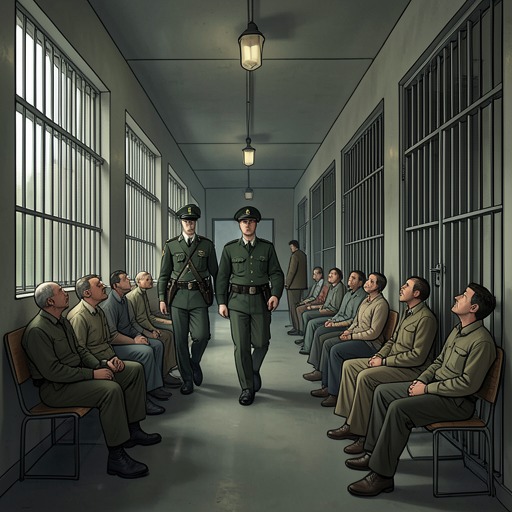
The rule is stated plainly in the account of Hoffmann’s threatened status: a prisoner who has been threatened should never be moved back to the unit he came from. When danger escalates in Block G, the prison riot squad takes Hoffmann under armed escort through the prison to Block C, the voluntary-isolation unit. Six officers remain behind to deter further violence, while four escort him, two in front and two behind. The unit has the familiar facilities of a prison wing, but separates its residents from prisoners in other units; its protective value lies in that separation.
The safeguard operates alongside ordinary prison controls over movement and access. Hoffmann’s transfer to isolation does not make him free to leave, but it creates distance between him and the people he fears. The rule therefore concerns more than which cell a prisoner occupies: in a closed institution, returning someone to a former unit can undo the practical protection that a separation was intended to provide.
Hoffmann’s exposure to danger
Hoffmann’s position in Aspsås Prison is shaped by a criminal identity built to withstand scrutiny. Before entering the prison, he has studied the buildings and the prisoners and staff of Block G with Erik Wilson’s help. After arriving, he deliberately sits where the other prisoners will see him, occupying a familiar chair and beginning a game of solitaire without asking permission. The display is calculated to establish a place in the unit’s informal order, but it also puts him in view of people whose loyalty is conditional.
Stefan Lygas and Karol Tomasz Penderecki are among the Wojtek members serving long sentences at Aspsås Prison. Hoffmann expects them to help him remove competitors and take over the prison drug market; if they discover that he is Paula, they could instead become his executioners. Before Hoffmann arrives, the two have circulated information about his supposed criminal standing and obtained copies of records through Stefan’s lawyer. The papers help make his constructed background credible, yet they also bind his safety to the people helping sustain it.
That vulnerability is not confined to confrontations in the common areas. At night, Hoffmann relies on a pillow, a chair at the threshold and a sock between the door and its frame to give him a brief warning if someone tries to enter while guards cannot see or hear. The small measures underscore how little formal security can do at the moment it is least available. Later, Hoffmann concludes that one of the four people he had relied on for protection and escape has betrayed him. The danger behind the transfer safeguard is thus both institutional and personal: the unit he is sent back to may contain the people who know how to reach him.
The order to return him
The rule becomes an explicit point of conflict when a prison official tells Mariana Hermansson that he was ordered to move Hoffmann back to his former unit, despite the prohibition on returning a threatened prisoner. Hermansson later explains to Ewert Grens that the orders went further. The night before Hoffmann’s transfer was to be carried out, Lennart Oscarsson was instructed to allow a lawyer to visit a prisoner in Hoffmann’s unit, then prevent Hermansson or anyone else from questioning or meeting that prisoner. Oscarsson was also ordered to return the prisoner to the unit he had come from and to keep the gates shut, even if Hoffmann demanded that they be opened.
The danger lies in the combination. A return order would place Hoffmann back among those from whom he had been separated; the restrictions on questioning would impede others from checking the situation; and the instruction to keep the gates closed would obstruct an attempt to stop or reverse the movement. These measures turn a protective procedure into a means of controlling who can intervene. The evidence establishes that the orders were given and that they contradicted the stated safeguard; it does not establish that the threatened return was completed.
Institutional significance
The account places this breach within a wider pattern of information withheld from ordinary investigations. Grens finds 302 secret intelligence reports from the preceding year describing cases in which an informant’s work to expose one crime gave rise to another. He discovers that some investigations had collapsed even though relevant knowledge was already held within the police, and tells prosecutor Lars Ågestam that Ågestam had been involved in twenty-three cases closed without the information contained in the secret reports. The transfer order is not itself explained as one of those cases, but the parallel is consequential: in both settings, official action proceeds while critical information is kept from the people who might scrutinize it.
The book’s closing distinction between fact and fiction reinforces that institutional context. It states that the police have used criminals as covert human intelligence sources while denying and concealing the relationship, and that investigations and trials have consequently proceeded without correct information. It also describes police records and reports being used to construct credible criminal backgrounds. Against that backdrop, the threatened-prisoner transfer rule is more than a prison instruction: it is a clear standard against which the manipulation of Hoffmann’s custody can be judged. Its force depends on officials respecting it, and the episode shows how little protection a rule can offer when the authorities controlling movement, information and access act against its purpose.